Pages

Friday, 11 May 2018

English for Technical Communication--books 1 and 2

These two books were published in 2002 by Scitech Publications, Chennai. The copyright is with me.

You may find the following material absorbing. If you do, please recommend them to a publisher in your area.

Like the previous books, these books can be used gainfully to teach English to Arts and Science undergraduates as well.

Thanks in advance.

my email ID: kolilakh29@gmail.com
phone:9840327279


This Course book is in two volumes.

English for Technical Communication Volume 1

Its preface is in Thamizh, the state language of Thamizh Nadu, a Southern State of India. This book facilitates the effort put in by students from regional medium to learn science and technical subjects without difficulty by suggesting ways and means to not consider English as an obstacle. This also introduces you to equip themselves with skills to tackle written test, group discussion and interview, the three steps they have to go through to land a job successfully. Besides, it helps them with tips about how to retain their job.

Next it enables them to distinguish between hearing capacity and listening ability and improve your listening skills.

Of course there are other things as well that are important to them.

Contents
1. Getting ready for a job
   1. introduction
   2. discipline (subject) knowledge
   3. The English language
   4. Communicating
Getting ready to study technical subjects
       Lists of technical and scientific vocabulary in English and their Thamizh equivalents
2. Resources
3. Energy
4. The computer
5. Transport

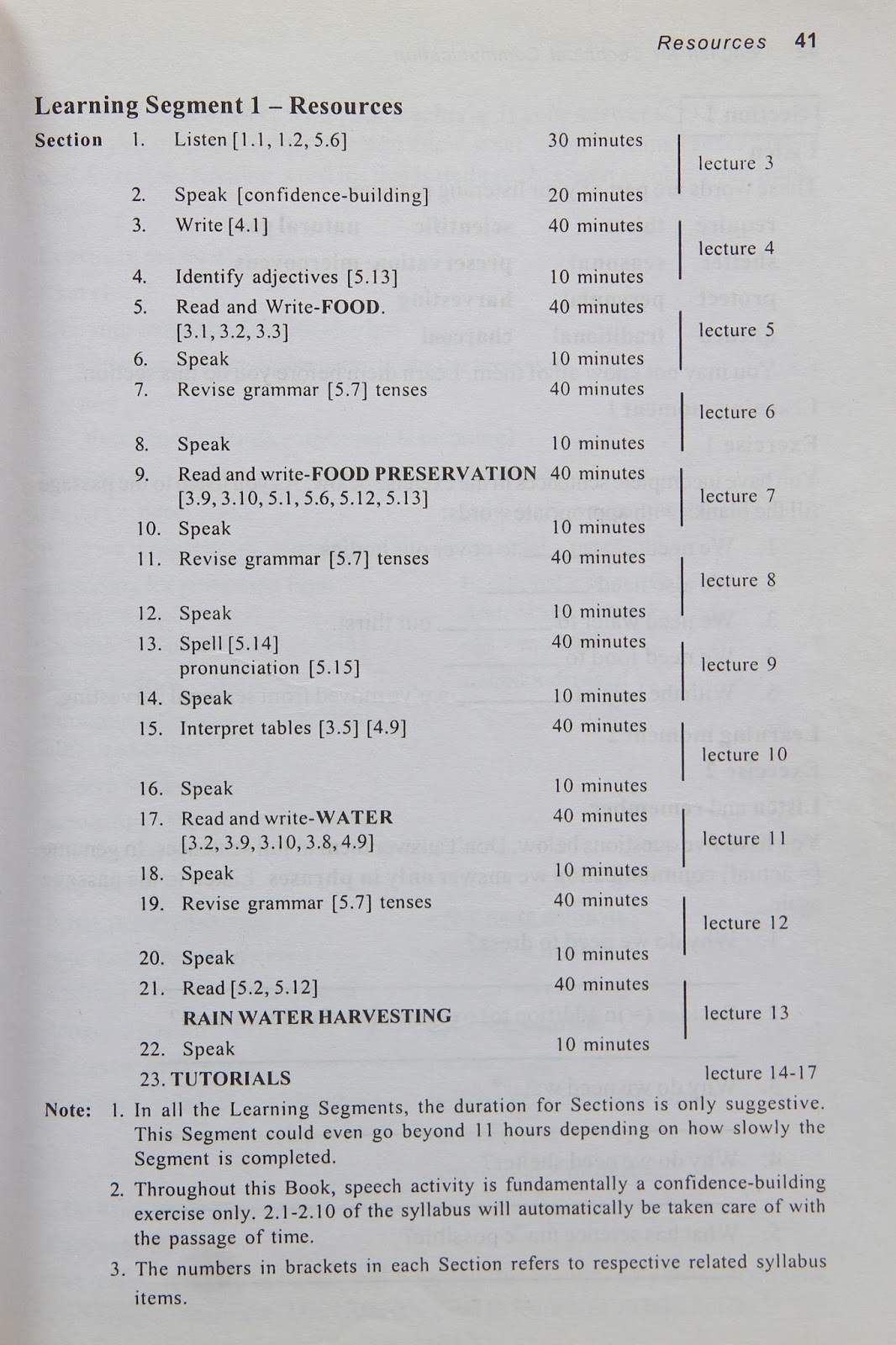
All the lessons are patterned after a specific design. Here is a sample:

Learning Segment 1—Resources
Section 1 Listen (1.1, 1.2, 5.6)                                                     30 minutes|
             2 Speak [confidence building]                                         20 minutes| lecture 3
             3 Write [4.1]                                                                     40 minutes|    
             4 Identify adjectives                                                         10 minutes| lecture 4
             5 Read and write—FOOD [3.1, 3.3, 3.3]                         40 minutes|
             6 Speak                                                                             10 minutes| lecture 5
          
             7 Revise grammar [5.7] tenses                                         40 minutes|
             8 Speak                                                                             10 minutes| lecture 6
          
             9 Read and write—FOOD PRESERVATION                 40 minutes|
                 [3.9, 3.10, 5.1, 5.6, 5.12, 5.13]
             10 Speak                                                                            10 minutes| lecture 7
          
             11 Revise grammar [5.7] tenses                                        40 minutes|
             12 Speak                                                                             10 minutes| lecture 8
          
             13 Spell [5.14], pronunciation [5.15]                                 40 minutes|
             14 Speak                                                                             10 minutes| lecture 9

             15 Interpret tables [3.5, 4.9]                                                40 minutes|
             16 Speak                                                                              10 minutes| lecture 10

              17 Read and write—WATER                                             40 minutes|
                   [3.2, 3.9, 3.10, 3.8, 4.9]
              18 Speak                                                                               10 minutes| lecture 11

              19 Revise grammar [5.7] tenses                                           40 minutes|
              20 Speak                                                                               10 minutes| lecture 12

              21 Read [5.2, 5.12] RAIN WATER HARVESTING           40 minutes|
              22 Speak                                                                                10 minutes| lecture 13
          
              23 TUTORIALS                                                                    lectures 14—17

Note:  1. In all the Learning Segments, the duration for Sections is only suggestive. This
              Segment could even go beyond 11 hours depending on how slowly the segment is
              completed.
           2. Throughout this Book, speech activity is fundamentally a confidence-building
               exercise only. 2.1—2.10 of the syllabus will automatically be taken care of with
               the passage of time.
           3. The number in brackets in each Section refers to respective related syllabus items.
___________________________________________________________________________


_________________________________________________________________________________ 

English for Technical Communication Volume 2


This Volume has four themes: Technology, Communication, Environment and Industry. All thse affect our lives, mould our thoughts and shape our beliefs.

The exercises will make learners think, analyse, reason, infer, imply and express appropriately. They should prepare themselves for the exercises one week before the actual lecture hour. 

This Volume ends with the remaining parts of How to get a job and retain it? They consist of Cocurricular activities—seminars, paper presentations, Getting a job—the written test, the G.D., the interview, Retaining the job—pair communication, brainstorming, oral presentation, conferences, reports and listening.

Learning Segments here have the same pattern as the ones they found in Volume 1.

A Note: These two volumes and all subsequent course books have been based on the
              syllabuses prescribed by Anna University.


_________________________________________________________________________________ 


Thursday, 10 May 2018

Effective Technical English

This book was published in 1999 by Scitech Publications. The copyright is with me.

You may find the information below engaging. If you do, please recommend it to a publisher in your area so that students of English may benefit.

Thanks in advance.

my email ID: kolilakh29@gmail.com
phone:9840327279


Effective Technical English conforms to the English syllabuses of B.E. students of Jawaharlal Nehru Technical University, Hyderababd, Andhra Pradesh, India.

This is what Professor Jacob Tharu, former Head, Department of Evaluation, CIEFL, Hyderabad said of the first coursebook:
           This ‘Course-book with a difference’ as the author describes it will
           without doubt be a sound and accessible resource relating to English
           proficiency for engineering students. It presents compactly in one
           book—yet quite comprehensively—the essentials of the English
           language. The author has taken care to cover the main areas
           indicated in the syllabus for B.E. Technical English prescribed by the
           JNTU. At the same time there is extensive matter providing practice
           for the major sections of the TOEFL examinations and typical all India
           competitive examinations. It will thus be useful for the first year students
           with an English requirement and for those in higher classes. Indeed, I
           expect this latter group to make even fuller use of the book than the
           juniors. I have noted over recent years that engineering students who
           see first year ‘compulsory English’ as a chore begin later to appreciate
           the value of effective proficiency in English. In the senior years they
           need to use English—to formulate project proposals, write technical reports,
           make oral presentations, interact with professionals during practical training,
           prepare for job interviews etc. students at this stage of study will surely find
           this new book a handy and dependable companion.

            It is user oriented and user friendly in the best sense...

 _________________________________________________________________________________________ 


English for Technical Communication

This book was published in 1998 by Scitech Publications, Chennai. The copyright is with me.

You may find the information below absorbing. If you do, please recommend it to a publisher in your area so that readers may benefit.

Like 'a means to an end', this book can be used even for Arts and Science undergraduates, replacing the technical-oriented content to general theme content. 

Thanks in advance.

my email ID: kolilakh29@gmail.com
phone:9840327279


English for Technical Communication went into three editions.

This Coursebook conformed to the learning pattern set by the new syllabus of Madras University.. This is in two parts.

Part 1 has six sections. There is a section each on grammar, reading comprehension, dialogue writing and notemaking, transcoding and technical report writing, letter writing and essay writing. Each section gives you sufficient guidelines to use English for various purposes.

Part 2 deals with writing assignments, paper presentation and listening in three different sections. These are new welcome additions. They introduce you to two communicating abilities: (a) expressing technical information and (b) comprehending information through listening.


I hope that by the end of the academic year you will have gained enough confidence in using English to listen, read, write and speak in the bargain in order to communicate (speak and write) your needs to others and to understand (listen and read) others’ needs as well.  
_________________________________________________________________________________